Film stills: search 2 million cinematic frames by mood, style, and era
Flim is a film stills database of over 2 million frames from films, series, commercials, music videos and fashion films. You can search it in plain language, describing a mood, a quality of light or an era, or narrow results with filters for shot type, colour and frame size, then save the stills you find to shared boards.
The frame exists. Somewhere in the last fifty years of cinema, a cinematographer captured exactly the quality of light, the depth of field, the colour temperature you are reaching for. Finding it has always been the hard part. Free archives give you a gallery to browse. ShotDeck gives you a metadata filter. Neither gives you a search engine that understands the description you already have in your head. Flim's film stills database combines over two million frames from films, commercials, series, and music videos with AI semantic search, so the language of your brief becomes the language of your search.
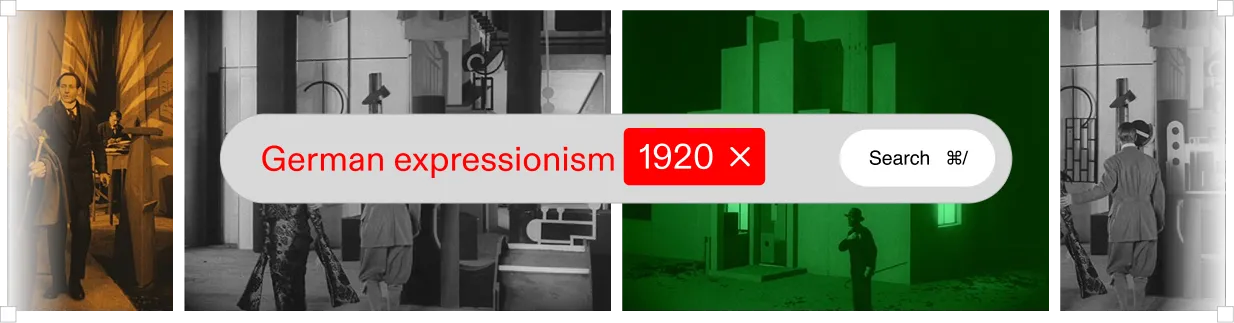
What are you actually looking for when you search for film stills?
Most databases are built around a search that professionals rarely do. They assume you know the film, the director, or the cinematographer, and that what you need is a way to retrieve a still from a title you already have in mind. That is one use case. It is not the most common one.
What an art director, a DOP, or a creative director more often needs is something harder to file: a particular quality of light in a hallway, a facial composition that carries the right kind of weight, a palette that lands between cold and lonely. Not a screenshot of a specific scene. A visual quality that exists somewhere in the canon of cinema and needs to be found.
You are not looking for a screenshot. You are looking for a specific visual quality. That distinction is what separates a professional reference database from an archive. Most film stills databases are archives. They index what exists. Flim is built to find what you are looking for, and those are not the same thing. The entry point is a cinematic moodboard that starts with a search, not a title.
What does Flim's film stills library cover?
Flim's film stills library covers over two million frames. Films, TV series, commercials, music videos, fashion films, and documentaries. Not a curated selection, but a working database, built for the breadth of references that professionals actually draw from.
The geographic and historical range matters here. ShotDeck was built by a Hollywood cinematographer, and its strengths are in the American studio canon, with technical metadata that serves DOPs who already know the film they want to reference. Flim's library spans European art cinema, world cinema, contemporary television, and commercial work from across decades and geographies.
That last category, advertising and music videos, deserves its own note. The most inventive cinematography of the last two decades did not happen only in feature films. Some of the sharpest visual language came from commercials directed by Romain Gavras, music videos by Hiro Murai, fashion films where a director had two minutes and total creative freedom. These are the references that a commercial director or an art director is actually looking for, and they are absent from databases built around theatrical releases. Flim covers them.
Flim has +2 million frames from films, TV, commercials, music videos, fashion films. If the visual language was strong enough to reference, it is in the database. Including the formats that other databases chose not to index.
The visual reference tool that results is not a niche archive. It is a working database for the full range of what professional creatives actually reference.
How do you search film stills by mood or style?
Flim combines two complementary search modes. The AI Search is semantic: describe the image in your head in natural language (mood, colour, era, emotional register) and the engine surfaces frames that match the feeling, not a title. But Flim also has filters: shot type, colour, dimensions, and technical parameters for when the search is more precise. Both approaches serve different moments in the creative process, and Flim covers both.
Low contrast, bleached palette, 90s music video energy. Deep focus, arid landscape, dust in the air, Spaghetti Western light. Close-up of hands, warm tungsten, something Eastern European from the 70s. These are real search inputs that return real film stills, not a title suggestion, not a "did you mean", a visual result. Flim works when you know what you want but not where it is, and equally when you don't yet know what you're looking for. Search "surrealism", filter by decade, and let the library surprise you. The depth of the archive is the point.
That is a fundamentally different tool from ShotDeck, which is excellent when you already know the film and want the frame. Flim covers the earlier moment in the creative process, when the visual idea exists but the source does not. For those switching from metadata-based databases, the ShotDeck alternative page covers the comparison in detail.

From still to moodboard to pitch
Finding the right film still is the beginning of a workflow, not the end of one. Flim is built for what happens next.
A DOP looking for palette references before a location scout pulls 15 frames onto a board and sends a link to the director before the first conversation. The meeting starts with shared visual ground instead of a description neither person can quite make concrete.
An art director preparing a client pitch selects 30 frames across different sources, arranges them by visual register, and shares a link. The board becomes the pitch document. And for those who need a deck format, Flim is available on Canva.
Magic Board accelerates this workflow: paste in a script or pitch, and Flim assembles a reference board from it, following the chronology of the text. The AI interprets the visual language of the text and surfaces the frames that match it. Then, when the brief calls for original visual content, the Aesthetics feature and AI models (Nano Banana for images, Veo and Seedance for video) generate new visuals in the visual style of the references. From the frame you found to the brief your team acts on.
The whole workflow stays inside one platform. No tab-switching, no import friction, no version confusion about which board is current. For teams working across locations, this is not a small thing.
How it works
Type the visual quality you are looking for: mood, colour, era, composition, emotional register. Or use filters for shot type, colour, and technical parameters. Both modes, one platform.
Flim's AI returns matching film stills from over two million cinematic references. Filter, refine the description, or explore adjacent results to find the exact frame.
Pull frames into a board. Organise, share, and present. Or use Magic Board and Aesthetics to generate visuals that complete the moodboard vision.
Go further
Got
Questions?

Flim's library includes over two million frames from films, TV series, commercials, music videos, fashion films, and documentaries. The database is updated regularly as new productions are added.
Yes. Flim supports traditional lookup by name, film, or title alongside AI semantic search. The two approaches complement each other: use semantic search when you know the feeling but not the source, and name-based lookup when you have a specific reference in mind.
FilmGrab is a free archive, strong on breadth but static, with no AI search and no tools for building or sharing. ShotDeck is a professional metadata database with excellent filtering by technical parameters, but it leans toward Hollywood productions and does not include AI semantic search or generation. Flim combines over 2 million searchable media with AI Search and a full creative workflow.
Yes. Flim's library covers commercials, music videos, and fashion films alongside feature films and TV series. For creatives who reference contemporary visual language (advertising, clip culture, fashion film), this is a key distinction from film-only databases.
Frames found in Flim can be saved to boards and used for reference and internal creative briefing. For commercial licensing of film stills, Flim directs users to the relevant rights-holders. The platform is designed for professional creative reference use.