Build cinematic moodboards from the world's largest film library
You know the mood. The light in a late Tati film, the palette of a Deakins close-up, something between Dardenne brothers realism and Wong Kar-wai colour. The feeling is there, the references are not. Pinterest gives you noise. Milanote gives you an empty canvas. A cinematic moodboard is only as strong as the references that go into it. Flim gives you over two million frames from films, commercials, series, and music videos, searchable by the description you already have in your head. Describe the feeling, find the frame, build the board.
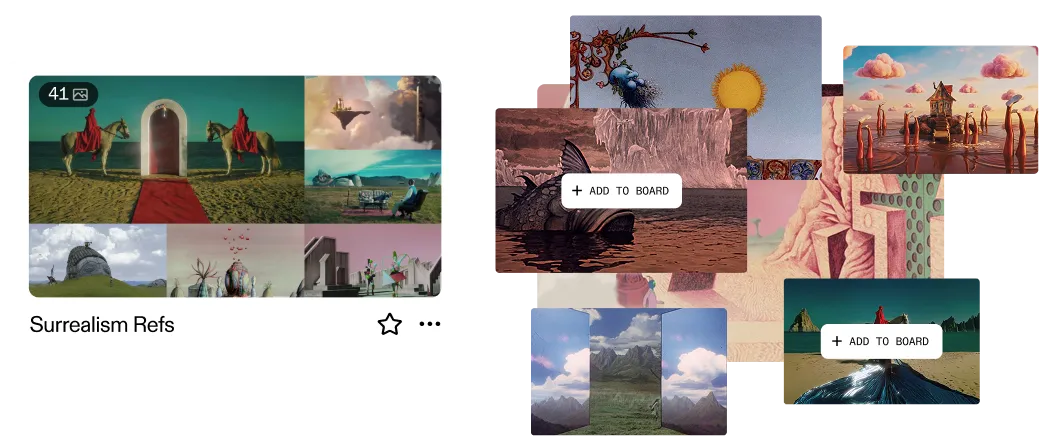
When a moodboard needs to feel like cinema
Most creative briefs start with a feeling, not a file. The art director has a texture in mind. The director has a colour temperature. The DOP has a reference from a film they saw years ago and can half-describe. The moodboard is the tool that turns those feelings into something a team can see and respond to.
Generic moodboard tools understand this in the abstract. In practice, they hand you a blank canvas and wish you luck. You end up on Pinterest, Google Images, and four other browser tabs, dragging screenshots into a Milanote board and hoping the resolution is good enough. A moodboard is only as strong as its references. And the references are still your problem to find.
The gap is not in the board-building. It is in the reference-finding. A cinematic moodboard tool should come with the cinema inside it. Flim does. Over two million frames from film stills, commercials, music videos, and series, all in one place, all searchable, all ready to pull into a board without leaving the platform.
Describe the feeling, find the frame
Flim's AI search engine does not work the way a database does. There are no tags to learn, no filter combinations to memorise, no cinematographer's name to remember. You describe what you have in mind, in the language you already use, and Flim finds the frame.
Cold blue morning light, 70s New York, low contrast. Overexposed white interior, silence, early Scandinavian drama. Handheld energy, neon rain, something between documentary and music video. These are real search inputs that return real results. Flim's AI search engine speaks visual. It is semantic search applied to cinema, not metadata matching dressed up as intelligence.
Not "cinematographer: Roger Deakins".
More like: "warm amber haze, a face half in shadow, the weight of something unsaid."
The contrast with the alternatives is real. ShotDeck, the dominant reference tool in the market, is built for technical lookup: filter by aspect ratio, lens, director. Useful for a DOP who knows exactly what they want and wants to prove it. Not useful for the art director three days from a pitch who needs to show a client how it feels. Flim covers both, and covers the ShotDeck alternative use case specifically for those who have outgrown the metadata-first approach.
From reference to board to creation
Finding the right frame is step one. Flim does not stop there.
Once you have selected your frames, you build: drag references onto a board, arrange, and share with your team or client. Boards are collaborative: an art director can add frames, a creative director can review direction, a producer can sign off the brief without being in the same room or timezone.
Magic Board takes this further. Paste in a treatment or a written pitch and Flim assembles a reference board from it automatically. The visual interpretation of your words, built in seconds rather than hours.
The Aesthetics feature extends your reference into generation. Set the visual style of a frame you found in the library, and generate new images in that style with Nano Banana, with the grain, light, and colour of cinema, not the smoothness of a generic AI generator. Then, when the creative brief calls for motion, Veo and Seedance take your still reference into cinematic video. From reference to generation, without switching tools.
This is the distinction that matters against any standalone moodboard tool. PureRef organises images you already have. Genery has a library but no generation layer. Flim is the only platform where the search, the board, and the generation are one continuous workflow, from the feeling in your head to the brief your team can see.

How it works
Describe the mood, colour, era, or feeling you have in mind. The AI Search returns matching frames across over two million cinema references: films, commercials, music videos, series.
Drag your selected frames onto a board. Share with your team and iterate before the pitch. Magic Board assembles a board from a script or pitch in seconds.
Generate original cinematic images with Nano Banana, locked to the visual style of your references. Extend into motion with Veo or Seedance for video. The grain, light, and depth of cinema, not the smoothness of a generic AI model.
Go further
Got
Questions?

Both. Flim combines a +2 million frame cinematic library with moodboard and collaborative board-building features. You search, collect, and build in one place, without switching between a reference database and a separate board tool.
A cinematic moodboard draws its references from films, series, and commercials rather than stock photography or random internet images. The visual language of cinema (composition, grain, colour, light) is more precise and culturally legible to a professional creative team than a Pinterest board.
Yes. Boards in Flim are shareable and collaborative. You can invite team members, allow annotations, and present directly from the platform.
Flim integrates and pre-configures leading AI models specifically for a cinematic aesthetic. Nano Banana handles image generation, while Veo and Seedance handle video. These are not generic generators: they are configured to produce visuals with the grain, light, and depth of a film frame.
Milanote is a blank canvas: powerful for visual organisation, but you bring your own references. The finding is entirely on you. Flim includes the library. Over two million cinematic frames, searchable by mood, colour, and feeling, ready to pull directly into your board without leaving the platform.
Genery and Flim serve overlapping needs but operate at different scales. Genery has a library and board tools but no generative AI layer. Flim combines the largest cinematic reference database available with AI Search and generation (Nano Banana for images, Veo and Seedance for video) in a single platform, built specifically for professional creatives.